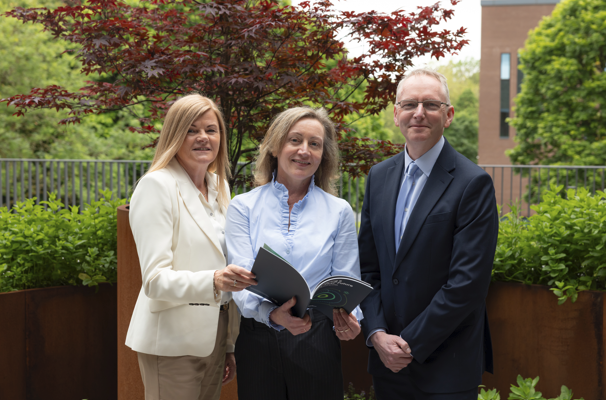

Engineering Skillnet has launched its new strategic plan, ‘Engineering a Skills-First Future 2026-2029', which outlines an ambitious roadmap to safeguard Ireland’s position as a global leader in engineering excellence by broadening the talent pool and accelerating learning velocity.
According to research, within the new strategy 84% of engineering employers are experiencing skills identification challenges, while 54% of all staff require significant upskilling or reskilling.
The Irish engineering sector, which comprises over 11,906 enterprises and employs 62,068 people, currently faces a rapid "Twin Transition" of digitalisation and carbon neutrality. To combat these challenges, the strategy advocates a fundamental shift from a traditional focus on job roles and fixed titles toward a more human-centric, "skills-first” approach to workforce development.
Pauline O’Flanagan, Director of Engineering Industries Ireland (Ibec), noted the strategy's critical alignment with national competitiveness: "In 2026, global competitiveness is defined not by hardware or capital investment alone, but by the skills agility of our workforce to operate and optimise increasingly complex, interconnected systems. To remain a global leader, Ireland must look beyond traditional job classifications and embrace a skills-first approach.”
Launching the strategy, Fiona Fennell, Network Manager of Engineering Skillnet, said: "Work is changing at a rapid pace, with jobs fragmenting and many skills now expiring quickly. Ireland has a uniquely multi-skilled workforce, but how we identify and develop talent needs to evolve. We believe that a 'skills-first' blueprint is essential to secure Ireland's economic future. This approach moves away from viewing talent purely through titles or credentials, prioritizing instead the balance of confidence and competence needed to perform work well. Given shifting geopolitics and demographics, this Strategic Plan represents a profound commitment to future-proofing skills mobility, starting right from the factory floor."
Dave Flynn, Director of Business Networks at Skillnet Ireland, emphasised the national economic impact of the new roadmap: "The engineering sector sits at the centre of Ireland’s economic future since it underpins so many core elements of our economy and society like infrastructure delivery, advanced manufacturing, energy transition and digital transformation. Even so, it is one of the sectors most exposed to skills disruption, and in the Engineering Skillnet's new Strategy we can see the scale of this challenge including a projected shortfall of more than 20,000 engineers and the growing pressure to integrate digital and sustainable skills into more traditional roles. This is why the Engineering Skillnet strategy introduces a critical concept in the ‘skills-first’ approach to workforce development, which aligns strongly with national policy.”

Stay connected with Skillnet Ireland
Receive regular news and insights from the world of workforce development straight to your inbox.
By adding my email, I agree to the use of my personal data in accordance with Skillnet Ireland's Privacy Policy.