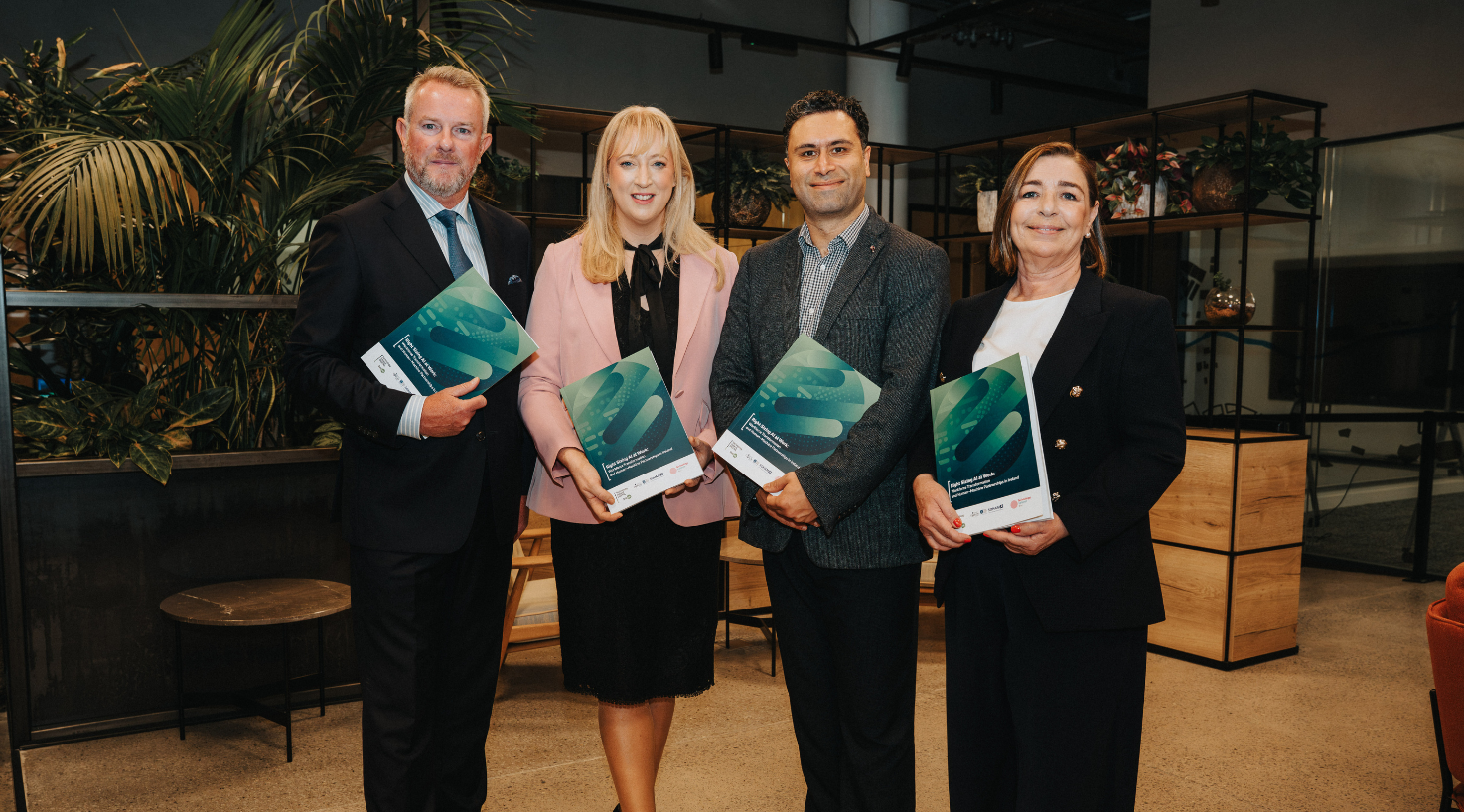

A new research study from Technology Ireland DIGITAL Skillnet highlights that Artificial Intelligence (AI) is changing work in Ireland for the better. According to the research, AI is transforming workplaces across Ireland, highlighting that competitive advantage comes not from technology alone, but from how organisations integrate AI into jobs, workflows and workforce development.
Commissioned by Technology Ireland DIGITAL Skillnet, the Right-Sizing AI at Work study was conducted by the Centre for Sociology of Humans and Machines (SOHAM), a joint centre at Trinity College Dublin and Technological University Dublin. The report was launched at professional services company Workday’s Dublin HQ.
The research finds that AI is increasingly supporting workers across a range of occupations, with the most significant changes occurring at the level of tasks and workflows, rather than through the elimination of jobs. Workers are increasingly required to review, verify, coordinate and exercise judgement over AI-supported outputs, highlighting the growing importance of effective human-machine partnerships.
These findings come at a time when Artificial Intelligence is emerging as one of the most transformative forces shaping the future of work, business competitiveness and economic growth.
Mark Jordan, Chief Executive, Skillnet Ireland, said: “Artificial Intelligence represents one of the most significant opportunities for Ireland’s future competitiveness, but as this research shows, its value will ultimately be determined by how we prepare people and organisations to harness it effectively. Through our industry-led approach, Skillnet Ireland is working with enterprise to equip the workforce with the practical skills and confidence needed to thrive in an AI-enabled economy and support Ireland’s ambition to be a global leader in talent, innovation and digital transformation.”
Una Fitzpatrick, Director of Technology Ireland, said: “Businesses across Ireland are increasingly embracing AI to streamline processes, improve decision-making and free up their people to spend more time on strategic priorities. To maximise these benefits, organisations are investing in workforce capability, leadership, governance and practical skills development. The findings highlight the importance of continued collaboration between enterprise, Government and the education and training sector to ensure Ireland has the talent and capabilities needed to succeed in the AI era."
The research found that AI use is already a common feature of working life for many employees, with almost half of respondents reporting regular use of AI tools across a wide range of workplace activities. However, widespread use has not been matched by a strong sense of dependency, with many workers continuing to view AI as a support tool rather than something essential to completing their work.
Máire Hunt, Director Technology Ireland Digital Skillnet, said: “One of the clearest messages from this research is that using AI and generating real business value from AI are two very different things. The organisations seeing the greatest benefit are those investing in the skills, capabilities and ways of working needed to embed AI effectively into real business processes. We commissioned this research to give employers a robust evidence base for those decisions and to ensure the programmes we develop with industry remain practical, relevant and aligned to the challenges businesses are facing today.”
The survey participants generally expressed confidence in their ability to use AI and adapt their skills for future AI-enabled workplaces. However, the study identified a gap between confidence and participation in formal training, suggesting a need for more structured, practical and role-specific skills development.
Key findings include:
- 41.5% of workers do not think AI could replace significant parts of their job in the future.
- 47.4% of workers use AI tools daily in their role.
- 57.1% say AI is used by many professionals in their field of work.
- 64.7% describe themselves as confident or very confident using AI tools.
- 69% feel prepared to adapt their skills to work alongside AI.
- 40.9% report no dependency on AI tools.
Lead Researcher of the Study, Professor Taha Yasseri, Workday Professor of Technology and Society, Trinity College Dublin, said: "Our research finds that AI's impact on work in Ireland is currently best understood as a process of task and workflow transformation rather than immediate large-scale job displacement. The challenge for organisations is to design effective human-machine partnerships that improve productivity while preserving learning, accountability, expertise and job quality."
Graham Abell, Vice President of Software Engineering and Ireland Site Lead, Workday, added: " AI can only create lasting value when it's paired with quality data, organisational context and trusted governance. This report provides important evidence that getting these foundations right is what helps move organisations beyond experimentation towards sustainable, responsible AI implementation."
The report concludes that Ireland's key challenge is to move from fragmented AI tool adoption towards deliberately designed human-machine partnerships, where organisations make informed decisions about what should be automated, augmented or delegated while ensuring accountability, inclusion and upskilling remain central.
The study highlights the importance of enterprise-led approaches to workforce development and notes Ireland's strong emphasis on digital skills, lifelong learning, enterprise support and workforce capability.
The full Right-Sizing AI at Work: Workforce Transformation and Human-Machine Partnerships in Ireland study, is available to download here https://www.skillnetireland.ie/insights/right-sizing-ai-at-work-workforce-transformation-and-human-machine-partnerships-in-ireland.

Stay connected with Skillnet Ireland
Receive regular news and insights from the world of workforce development straight to your inbox.
By adding my email, I agree to the use of my personal data in accordance with Skillnet Ireland's Privacy Policy.